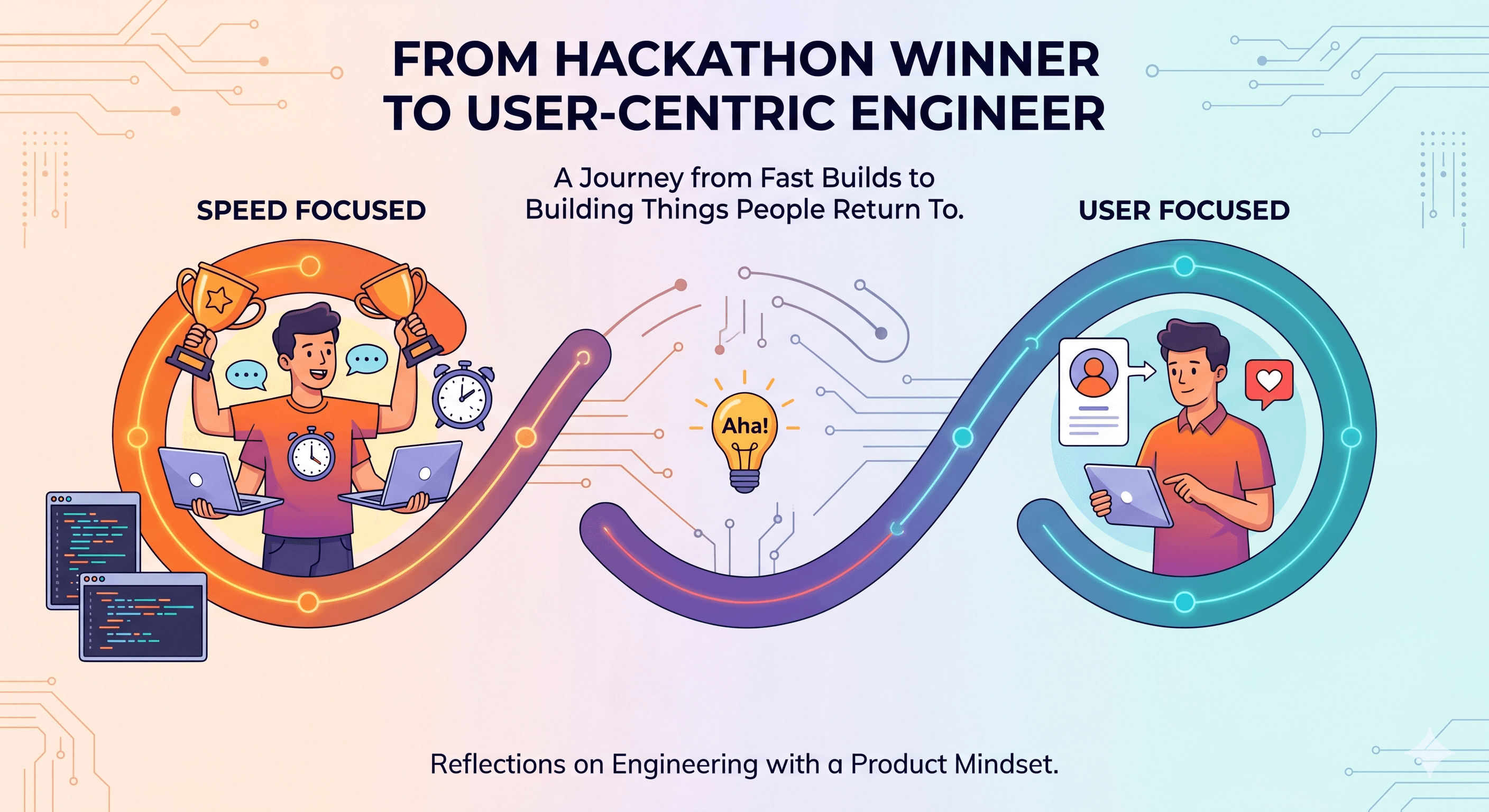
How Building a Startup Changed How I Work as an AI Engineer
From building projects to building products: My journey
There was a time when I measured my progress in wins.
Hackathons, rankings, final rounds—those were my checkpoints. And honestly, I was good at it. I knew how to build fast, demo smart, and ship something impressive within 24–36 hours.
In that world, the rules were simple:
- Build something that works
- Make it look good enough
- Explain it confidently
And it worked. We won. Repeatedly.
At that point, I genuinely believed:
If you can build fast and make things work, you’re a good engineer.
I wasn’t wrong. But I wasn’t complete either.
When Hackathon Thinking Became a Problem
After a while, we decided to build something real.
Not a demo. Not a prototype.
A startup.
And without realizing it, we carried the same hackathon mindset into it.
- Build fast
- Ship quickly
- Fix later
At first, it felt natural. We were moving fast, pushing features, constantly improving.
But reality hit almost immediately.
Things started breaking. Not occasionally—regularly.
And unlike hackathons, this wasn’t something you could explain away in a presentation.
- A broken flow meant a user dropped off
- A confusing output meant they didn’t trust the product
- A small bug could kill the entire experience
It wasn’t just “something broke.”
It was fatal.
The Hard Truth: Nobody Comes Back
The biggest shock wasn’t bugs.
It was silence.
People tried the product once… and didn’t come back.
No feedback. No complaints. Just absence.
And that’s worse than criticism.
Because it means:
The product didn’t matter enough to react to.
We had built things that worked. But they weren’t usable. They weren’t reliable. They weren’t needed.
For the first time, speed stopped being an advantage.
It became the problem.
Six Months That Changed Everything
Over the next six months, something slowly started changing.
Not in a dramatic, motivational way.
More like repeated friction shaping how I think.
I started noticing patterns:
- Users don’t care how fast you built it
- They care how easily they can use it
- They don’t explore—they drop off
- They don’t forgive—they leave
So naturally, my approach began to shift.
I stopped asking:
“What can we build next?”
And started asking:
“What should we not build?”
I began thinking about:
- reducing steps instead of adding features
- clarity instead of capability
- reliability instead of speed
And most importantly:
Building something once is easy. Building something people return to is hard.
What Changed in Me as an Engineer
This experience rewired how I approach problems.
I still build fast. That hasn’t changed.
But now, there’s a filter:
- Is this actually useful?
- Is this simple enough for someone new?
- What happens if this breaks?
I think less like someone completing tasks…
And more like someone responsible for an experience.
Why This Matters in My work
This shift became very real during my time as an AI Engineer.
Earlier, I would hear product discussions like:
- “We need better user experience”
- “This flow isn’t working”
- “Users are dropping here”
And I’d translate them into technical improvements.
Now, I understand what’s actually being said.
When the CEO talks about the product, I don’t just hear features.
I understand:
- what the user is struggling with
- where the friction is
- why something needs to change
Because I’ve seen those same problems in my own startup.
From Features to Users
The biggest difference is this:
Earlier, I built features.
Now, I think in terms of users.
Not “Can we add this?”
But “Will this help someone?”
Not “Is the model better?”
But “Is the output clearer?”
That shift sounds small.
But it changes everything.
Closing Thought
Hackathons taught me how to build.
Startups taught me what not to build.
And somewhere between broken features, silent users, and slow iterations…
I stopped trying to impress people with what I made.
And started trying to make things people would actually use.